
Faraday’s Law: The Physics of Conductive Fluid Measurement
Electromagnetic flow measurement is one of the most widely used methods for measuring the flow of conductive liquids in industrial processes. From water treatment and chemical processing to food production and environmental monitoring, this technology is valued for its accuracy, reliability, and minimal pressure loss. At the heart of this measurement principle lies a fundamental concept of classical physics: Faraday’s Law of Electromagnetic Induction.
Understanding how Faraday’s Law applies to conductive fluid measurement helps engineers, technicians, and decision-makers better evaluate electromagnetic flow meters, interpret measurement behavior, and select suitable instruments for their process conditions. This article explains the physics behind electromagnetic flow measurement in a clear, structured way, without assuming prior expertise in electromagnetism.
What Is Faraday’s Law?
Faraday’s Law of Electromagnetic Induction states that a voltage is induced in a conductor when it moves through a magnetic field, provided the motion cuts across magnetic field lines. The magnitude of the induced voltage depends on three core factors:
-
The strength of the magnetic field
-
The velocity of the conductor
-
The effective length of the conductor within the magnetic field
In mathematical form, the induced voltage is proportional to the product of these three variables. While the full equation is often expressed in physics notation, the practical implication is simple: faster movement through a stronger magnetic field generates a higher voltage.
In electromagnetic flow measurement, the “conductor” is not a metal wire, but the conductive fluid itself.
Why Conductive Fluids Matter?
Faraday’s Law only applies when the moving medium can conduct electricity. This is why electromagnetic flow meters are designed specifically for conductive liquids, such as:
-
Water and wastewater
-
Slurries and mineral suspensions
-
Many food and beverage liquids
Non-conductive fluids, such as oils, gases, and hydrocarbons, cannot generate a measurable induced voltage and therefore cannot be measured using this principle.
The minimum conductivity required for reliable measurement depends on the specific flow meter design, excitation method, and signal processing, which must be defined by the manufacturer’s documentation.
How Faraday’s Law Is Applied in Flow Measurement?
In an electromagnetic flow measurement system, Faraday’s Law is applied in a controlled and repeatable way.
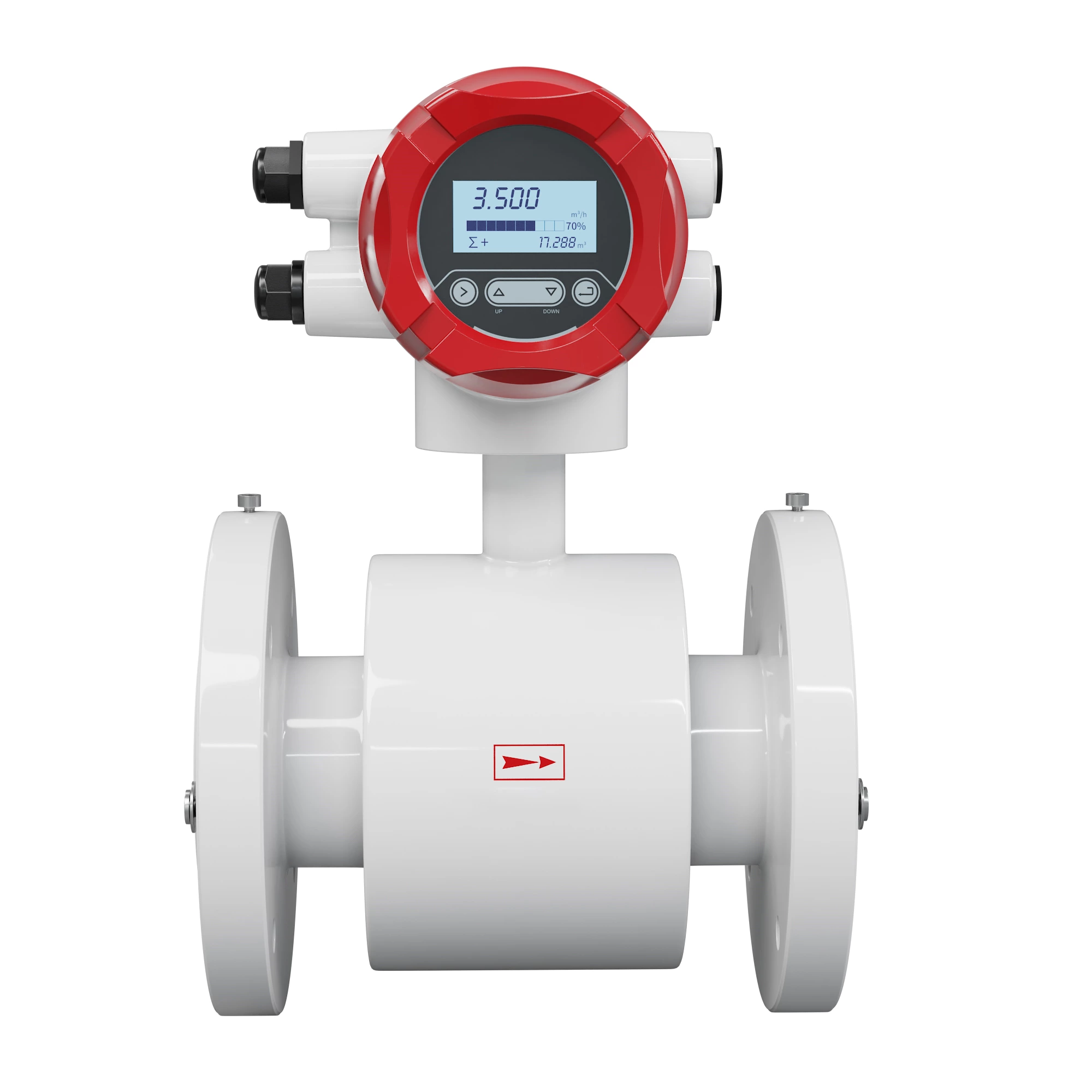
A magnetic field is generated across a section of pipe using coils positioned outside the flow tube. As the conductive fluid flows through this magnetic field, it behaves like a moving conductor. Electrodes installed on opposite sides of the pipe detect the voltage induced by the fluid’s motion.
This induced voltage is directly proportional to the average velocity of the fluid flowing through the pipe. Because volumetric flow rate is the product of velocity and cross-sectional area, the flow meter can calculate flow rate once the pipe diameter is known.
Importantly, this measurement principle does not rely on moving mechanical parts, pressure drop, or fluid density.
Key Physical Relationships in Electromagnetic Flow Measurement
Although electromagnetic flow meters vary in construction and signal processing, the underlying physics remains consistent.
Velocity and Induced Voltage
As fluid velocity increases, the induced voltage measured at the electrodes increases proportionally. This linear relationship is one of the reasons electromagnetic flow meters are known for stable and predictable output across a wide flow range.
Magnetic Field Strength
A stronger magnetic field produces a higher induced voltage for the same fluid velocity. In practice, magnetic field strength is controlled by the excitation system within the transmitter, which may use steady or pulsed excitation depending on the design.
Pipe Diameter and Measurement Geometry
The distance between electrodes effectively defines the “conductor length” in Faraday’s Law. This means pipe diameter directly influences the signal magnitude and must be accurately configured during installation or commissioning.
Why Electromagnetic Flow Measurement Is Non-Intrusive?
One of the practical advantages of Faraday-based flow measurement is that nothing obstructs the flow path. The flow tube is typically smooth and unobstructed, with electrodes flush to the pipe wall.
Because the measurement relies on electromagnetic interaction rather than physical contact with moving parts:
-
There is no mechanical wear due to the flow
-
Pressure loss is negligible
-
Performance is largely independent of fluid viscosity, temperature, and density
Any limitations or material compatibility concerns depend on the liner and electrode materials, which must be selected according to the specific application.
Signal Detection and Noise Considerations
The induced voltage generated by a flowing fluid is relatively small, often in the millivolt range. As a result, electromagnetic flow meters must be designed to distinguish the true flow signal from electrical noise.
Sources of interference may include:
-
Electrode polarization effects
-
Electrical noise from nearby equipment
-
Flow profile disturbances
Modern electromagnetic flow meters address these challenges through excitation control, signal filtering, and grounding strategies. The effectiveness of these methods depends on the specific transmitter design and installation quality.
Flow Profile and Measurement Accuracy
Faraday’s Law assumes that the measured voltage represents the average velocity of the fluid across the pipe cross-section. In practice, flow profile distortions caused by elbows, valves, or pumps can affect measurement stability.
To minimize these effects, electromagnetic flow meters are typically installed with sufficient straight pipe lengths upstream and downstream, as specified by the manufacturer. Proper installation ensures that the induced voltage accurately reflects the true volumetric flow rate.
Why Faraday’s Law Enables Bidirectional Measurement?
Because the polarity of the induced voltage depends on flow direction, electromagnetic flow meters can inherently detect both flow rate and flow direction. When the fluid reverses direction, the polarity of the measured voltage also reverses.
This behavior is a direct consequence of Faraday’s Law and does not require additional mechanical or sensing components.
Limitations Imposed by the Physics
While Faraday’s Law is powerful, it also defines clear boundaries for electromagnetic flow measurement.
-
Only conductive fluids can be measured
-
Empty or partially filled pipes cannot produce valid signals
-
Very low flow velocities may generate voltages close to the noise floor
These limitations are inherent to the physics itself and cannot be eliminated by electronics alone.
Why Faraday’s Law Still Matters Today?
Despite being formulated in the 19th century, Faraday’s Law remains directly relevant to modern industrial instrumentation. Advances in materials, electronics, and digital signal processing have improved electromagnetic flow meters, but the core measurement principle remains unchanged.
Understanding this foundation allows users to better evaluate performance claims, installation requirements, and suitability for specific process conditions.
Conclusion
Faraday’s Law provides the physical foundation for electromagnetic flow measurement by linking fluid velocity, magnetic field strength, and induced voltage into a simple and reliable measurement principle. By treating a conductive fluid as a moving electrical conductor, electromagnetic flow meters achieve accurate, non-intrusive flow measurement without mechanical wear or pressure loss.
For engineers and operators working with conductive liquids, understanding this physics is essential for the correct application, installation, and interpretation of flow data.