Specification
| Product |
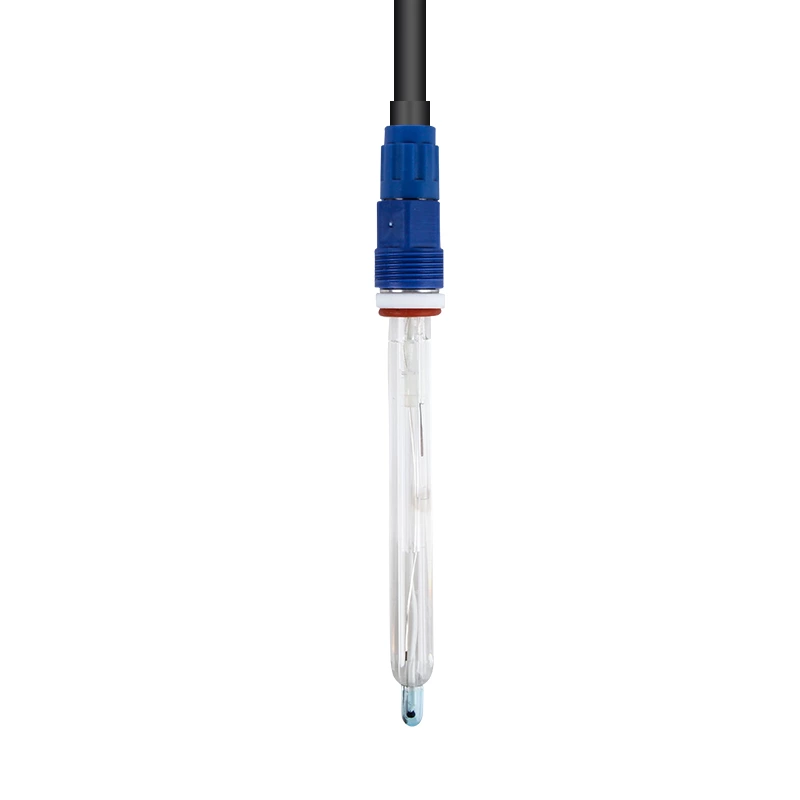
Glass pH sensor |
| Model |
MIK-PH5014 |
| Measurement range |
0-14 pH |
| Zero potential point |
7 ± 0.5 pH |
| Slope |
> 98% |
| Membrane resistance |
general: <250ΜΩ |
| Practical response time |
< 1 min |
| Thread Connection |
PG13.5 |
| Temp compensation |
NTC 10 KΩ/Pt1000 |
| Heat resistance |
0-130℃ for general cables |
| Pressure resistance |
2.5bar at 25 ℃ |
| Connection |
Low-noise cable |
Industrial wastewater engineering
Process measurements, electroplating plants, paper industry, drinks industry
Wastewater containing oil
Suspensions, varnishes, media containing solid particles
Two-chamber system for when electrode poisons are present
Media containing fluorides (hydrofluoric acid) up to 1000 mg/l HF
1. What is the MIK-PH5014 hydrofluoric acid pH sensor?
The MIK-PH5014 is a glass pH sensor with a pH-sensitive glass membrane that is resistant to hydrofluoric acid (HF). It is designed for pH measurement in water containing hydrofluoric acid.
2. Why can't a standard pH electrode be used with hydrofluoric acid?
Hydrofluoric acid attacks ordinary glass, so the glass membrane of a standard pH electrode can be damaged quickly, leading to drift and a short service life. The MIK-PH5014 uses a special HF-resistant glass membrane for these applications.
3. Where is the MIK-PH5014 used?
- pH measurement in water containing hydrofluoric acid
- Dilution control of hydrofluoric acid in semiconductor wafer manufacturing and chip production
- Industrial wastewater, including electroplating and other fluoride-containing process water
4. What HF concentration can it handle?
According to its application data, the sensor can be used in media containing fluorides (hydrofluoric acid) up to 1000 mg/L HF. Please send us your HF concentration, temperature and pH range so we can confirm suitability.
5. What are the measuring range, zero point and slope?
- Measuring range: 0–14 pH
- Zero potential point: 7 ± 0.5 pH
- Slope: >98%
- Practical response time: <1 min
6. What is the membrane resistance?
The membrane resistance is generally below 250 MΩ. Because this is a high-impedance signal, use a pH meter with a high-impedance input and a low-noise cable.
7. What temperature and pressure can it withstand?
- Temperature: 0 to 130 °C (with general cables)
- Pressure: 2.5 bar at 25 °C
Please tell us your process temperature and pressure so we can confirm the suitable configuration.
8. What is the thread connection?
The sensor uses a PG13.5 thread, a widely used standard for 12 mm process electrodes, fittings and flow cells.
9. What temperature compensation elements are available?
NTC 10 kΩ or Pt1000. Choose the element that matches your pH meter.
10. What cable is used?
The sensor uses a low-noise cable to maintain a stable signal from the high-impedance glass electrode.
11. Which pH meter can be used with the MIK-PH5014?
12. Is it suitable for semiconductor applications?
Yes. The MIK-PH5014 is used for hydrofluoric acid dilution control in semiconductor wafer manufacturing and chip production. Please tell us your process details, such as HF concentration and cleanliness requirements, so we can confirm the configuration.
13. How should the sensor be calibrated?
Calibrate with standard buffer solutions that bracket your process pH, such as Asmik standard pH calibration solutions. Rinse the sensor thoroughly between the process medium and the buffers.
14. How long does the sensor last in HF media?
Service life depends on HF concentration, temperature, pH and cleaning conditions. Even with an HF-resistant glass membrane, higher concentrations and temperatures generally shorten the life of the electrode, so regular checks and calibration are recommended.
15. How should the sensor be maintained and stored?
- Rinse the sensor after contact with HF-containing media.
- Keep the glass membrane wet and store the sensor with its protective cap when not in use.
- Check the slope and zero point regularly and recalibrate when needed.
- Follow safety procedures for handling hydrofluoric acid during maintenance.
16. What information should I provide to get a quotation?
To help us select the correct configuration, please provide:
- Application (wastewater, semiconductor HF dilution, other)
- HF concentration and pH range
- Process temperature and pressure
- Temperature compensation element (NTC10K or Pt1000)
- Cable length and installation fittings
- Matching pH meter (if required)
- Quantity
Send your requirements to info@asmik.com or contact us via WhatsApp at +86 13325716921.